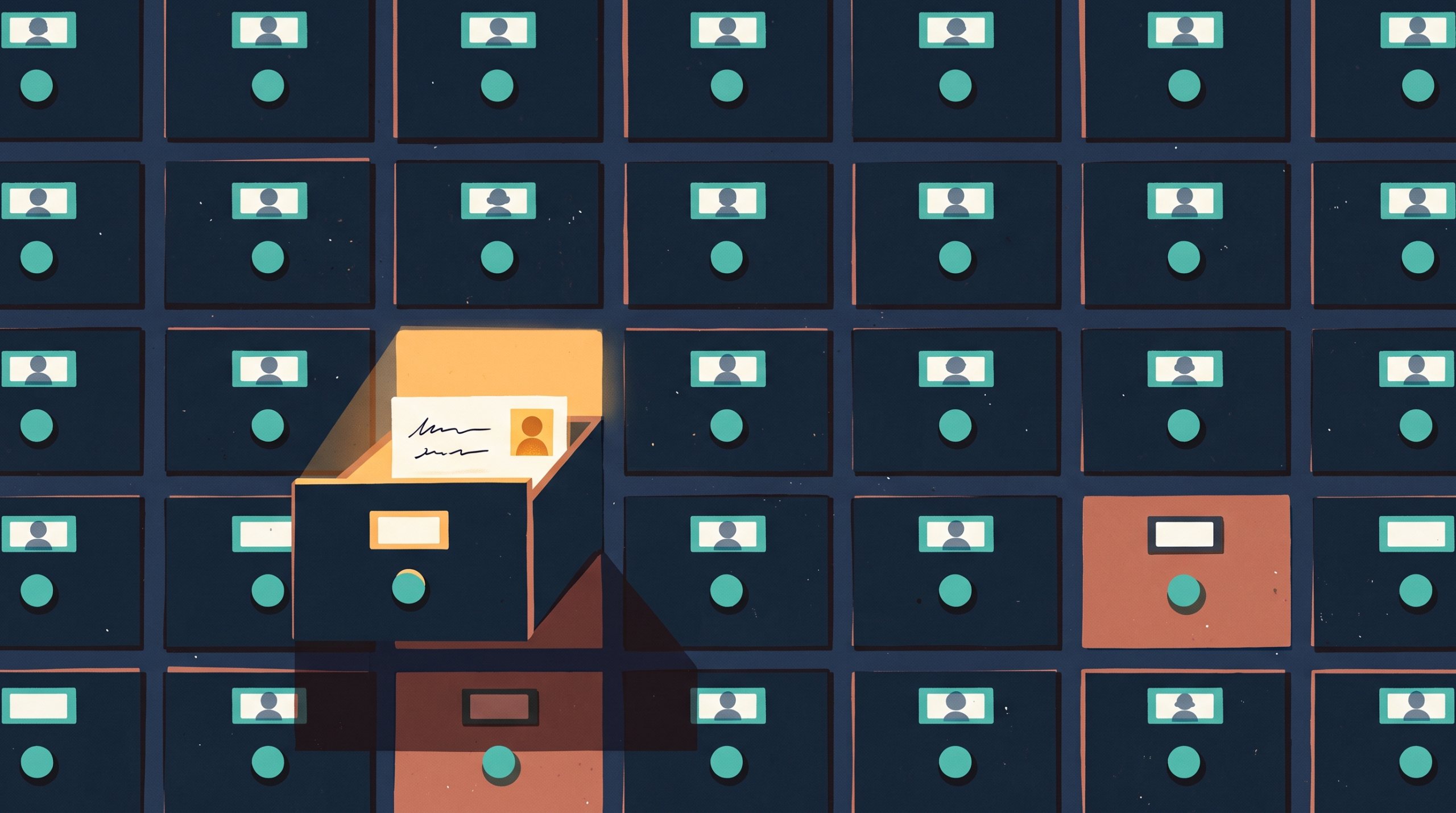
A client rings on a Tuesday about a flat she saw in February. Her name shows on the screen and nothing else. By the time you place her, she has explained twice who she is, and you can hear the patience thinning on the second explanation. Client relationship building lives or dies in moments exactly that small.
Nothing about that call is unusual, which is rather the point. Those few seconds repeat themselves a dozen times a week.
What follows is five habits rather than a philosophy. Each one is small, each one survives a busy week, and none of them requires you to be a different person on the phone.
One caveat before the list, because the honest version matters more than the motivational one. Trust does not close deals by itself. Research on services selling is clear about the split: relationship quality wins you the next conversation, while competence wins the business inside it. So these habits make selling easier, not automatic.
What client relationship building actually is
Most people hear the phrase and picture coffees, golf, and remembering birthdays.
In practice it is far more boring. It is the accumulation of small proofs that you were paying attention, delivered at moments when the other person expected you not to be.
A birthday text proves nothing, because everybody knows a calendar sent it. Mentioning that their lease ends in March, unprompted, in October, proves a great deal.
So the work is not social. It is clerical, and that is good news, because clerical work can be systematised while charm cannot.
Habit 1: Write one line while the call is still warm
Everything else here depends on this one, so start with it even if you ignore the rest.
When a call ends, write a single sentence with three things in it. Who the person is to you, what was agreed, and what happens next. “Seller, wants 48M, will decide after the valuation on Thursday” does the job.
Write it within sixty seconds. Memory for conversational detail falls off a cliff within the hour. By tomorrow morning you keep the gist and lose the specifics, which are the part that proves you listened.
Keep the line attached to the person rather than filed by date. You will go looking for it by name when the phone rings, not by scrolling back to a Tuesday in March.
I wrote a longer piece on what to put in call notes and where to keep them, since the where matters as much as the what.
Habit 2: Open with something only you could know
Your first sentence on an outbound call is the cheapest trust you will ever buy.
Compare two versions. The first, “Hi Anna, it’s me from the agency, how are you?”, asks her to work out who is speaking. Then the second: “Hi Anna, the ground-floor flat on Rose Street came up, and you said anything above the second floor was out because of your mother’s knees.” That one proves you were listening in February.
Both take eight seconds. Only one of them changes the temperature of the call.
Notice that the second version never announces the remembering. No “I remember you said”, no flattery. The detail does the work by itself, which is why it reads as evidence instead of technique.
Why the old detail beats the recent one
Recalling last week shows attention. A detail from February shows attention plus seven months of keeping it. That is a bigger compliment, and it costs you nothing extra when the note sits in front of you.
Check it is still true first, though. “How’s the new job?” lands badly when the job ended in June, and a stale detail does more damage than no detail at all.
Habit 3: Make contact when you want nothing
Here is the habit that separates people with a book of business from people with a pipeline.
Most of your calls carry an ask inside them. Consequently your number starts to mean “somebody wants something”. People then get slower to pick up, without ever deciding to avoid you.
So make a handful of calls each month with no ask in them at all. The valuation they wondered about came in. A street they liked has a new listing, wrong for them but worth knowing. Their building permit went through.
Thirty seconds, no request, then off the phone. Research on services selling found that intensive follow-up contact builds the buyer-seller bond. Of those contacts, the no-ask version is the one people remember.
Four of these a week is two hundred a year. Nobody in your market is doing that.
What to say when you have nothing to say
The no-ask call stalls for most people at the opening line, since calling without a reason feels like wasting somebody’s time.
Give yourself a small, true reason and the problem disappears. A price change on a street they mentioned. Some rule that now affects their building. An article about their industry.
Alternatively, use the oldest one in the business: “You crossed my mind this morning and I realised we hadn’t spoken since the spring.” That is honest, it carries no ask, and most people answer it warmly.
Keep the call shorter than they expect. Leaving while they still have energy for the conversation is what makes the next one easy.
Habit 4: Say the inconvenient thing early
Trust is built faster by costly honesty than by agreeable service.
Say a seller names a price twenty percent above the market. The easy path takes the listing and lets three silent months do the arguing. Saying so on day one, with the comparables in front of you, is the expensive path.
You lose some listings that way. Yet the ones you keep arrive pre-sold on your judgement. Several of the lost ones come back in spring, once the silent months have happened to somebody else.
The same applies to small things. Tell people when a viewing would waste their Saturday. Say so when the other agent’s offer beats yours.
Each of those moments costs you something visible, which is precisely why it registers as honest.
Habit 5: Keep the relationship yours, not the firm’s
A meta-analysis of the relationship marketing literature found that these efforts work better when the relationship is built with an individual person rather than with a selling firm.
That finding has a practical edge for anyone who may one day change office.
Keep your notes somewhere you own, such as your own contacts. A company CRM disappears on your last day. Answer your own phone, as well, and let clients keep one number for you across jobs.
None of this is disloyalty, because the firm gets a better-served client either way. It simply recognises who the client actually trusts, which is whoever remembered the garage.
Restarting with clients who have gone quiet
Most people reading this have a hundred contacts they have not spoken to in a year. That backlog feels like a reason not to start.
Treat it as a one-off job instead, and keep it crude.
Open your contacts and mark the twenty people most likely to transact in the next eighteen months. Not the nicest twenty. The twenty with a reason to move: a growing family, a lease ending, a business expanding, an inheritance in progress.
Write what you remember about each one, even when that is almost nothing. “Bought in 2022, two kids, mentioned wanting a garden eventually” is enough to start a conversation that doesn’t sound cold.
Then call four of them a week for five weeks, with no ask attached. Mention the thing you remembered, ask one question, and get off the phone inside two minutes.
Half will be pleased and nothing more will come of it. A few will have news, because eighteen months is long enough for life to happen to anybody. Those few are why the exercise pays.
Afterwards, you are no longer restarting. You are simply maintaining, which costs a fraction of the effort.
The five client relationship building habits, and what each costs
| Habit | Time it costs | What it changes |
|---|---|---|
| Write one line after each call | 30 seconds per call | Everything below becomes possible |
| Open with a specific detail | None, if the note is in front of you | The first ten seconds of every call |
| Call with no ask | Two minutes, four times a week | What your number means when it appears |
| Say the inconvenient thing | Some listings, some commission | Whether your advice gets believed |
| Own the relationship | One afternoon of setup | Who keeps the clients if you move |
Where client relationship building goes wrong
Three failures show up again and again, and all three are versions of faking the signal.
The first is automation pretending to be memory. Scheduled birthday messages, anniversary emails, newsletters addressed to a merge field. People sort these into the mental bin marked advertising, because that is what they are.
The second is detail without judgement. Knowing a client’s dog’s name while giving bad pricing advice is not a relationship. They will forgive a forgotten dog long before they forgive ninety days on market.
The third is collection rather than conversation. A note about what someone told you is warm. Something you worked out from their social media is surveillance, and the line is roughly whether they would be comfortable reading your file.
A word on CRMs
Plenty of agents conclude that these habits require software costing fifty dollars a month, then abandon the software by March.
The honest position is that most solo agents do not need a CRM at all, which I argued in an earlier post about whether realtors need one. Buy leads at volume and a real CRM earns its keep. Meanwhile the real cost of Follow Up Boss is laid out separately.
Otherwise your contacts app plus the five habits above beats an expensive system you stop updating.
A client relationship building routine for one week
Try the whole thing for five working days before deciding whether it suits you.
Monday, pick your twenty most important clients and write one line on each from memory. The gaps you find are the point of the exercise.
Tuesday through Friday, write a line after every call, without exception, including the dull ones.
Each morning, make two no-ask calls before you start on anything else. Keep them short.
Then on Friday, read back through the week’s lines. You will spot two or three people who need a call next week and would otherwise have gone quiet for a month.
That is the entire method. No CRM migration, no scripts, no coaching programme.
Where my app fits
This is the part about my own product, so weigh it accordingly.
Business Dialer Call Notes puts the line you wrote on the incoming call screen, with the person’s company and job title, before you answer. Notes live in your own Google Contacts rather than on my servers, which also happens to satisfy habit five.
It costs $9 a month, $49 a year or $99 once, after a 30-day trial, and it runs on Android only. A paper notebook does the same job more slowly, and plenty of excellent agents use one. What matters is whether the line reaches you before you say hello, rather than which tool delivered it.
If your phone currently shows a bare name when clients ring, that gap has its own post.
Why client relationship building works, in one paragraph
Remembering something about a person reads as a compliment, and compliments create a quiet sense of obligation. Obligation plus the feeling of being understood produces trust. Then trust predicts whether people take your advice and whether they return. In a business built on repeat clients and referrals, that is the whole game.
That chain is not my opinion. Each link in it has been tested separately, and I went through the studies one by one, including the ones that complicate the picture. The effect sizes are modest rather than magical, which is roughly what you would expect from something costing thirty seconds a call.
Modest compounds, though. Thirty seconds a call, across a year of calls, is the difference between a client list and a contact list.