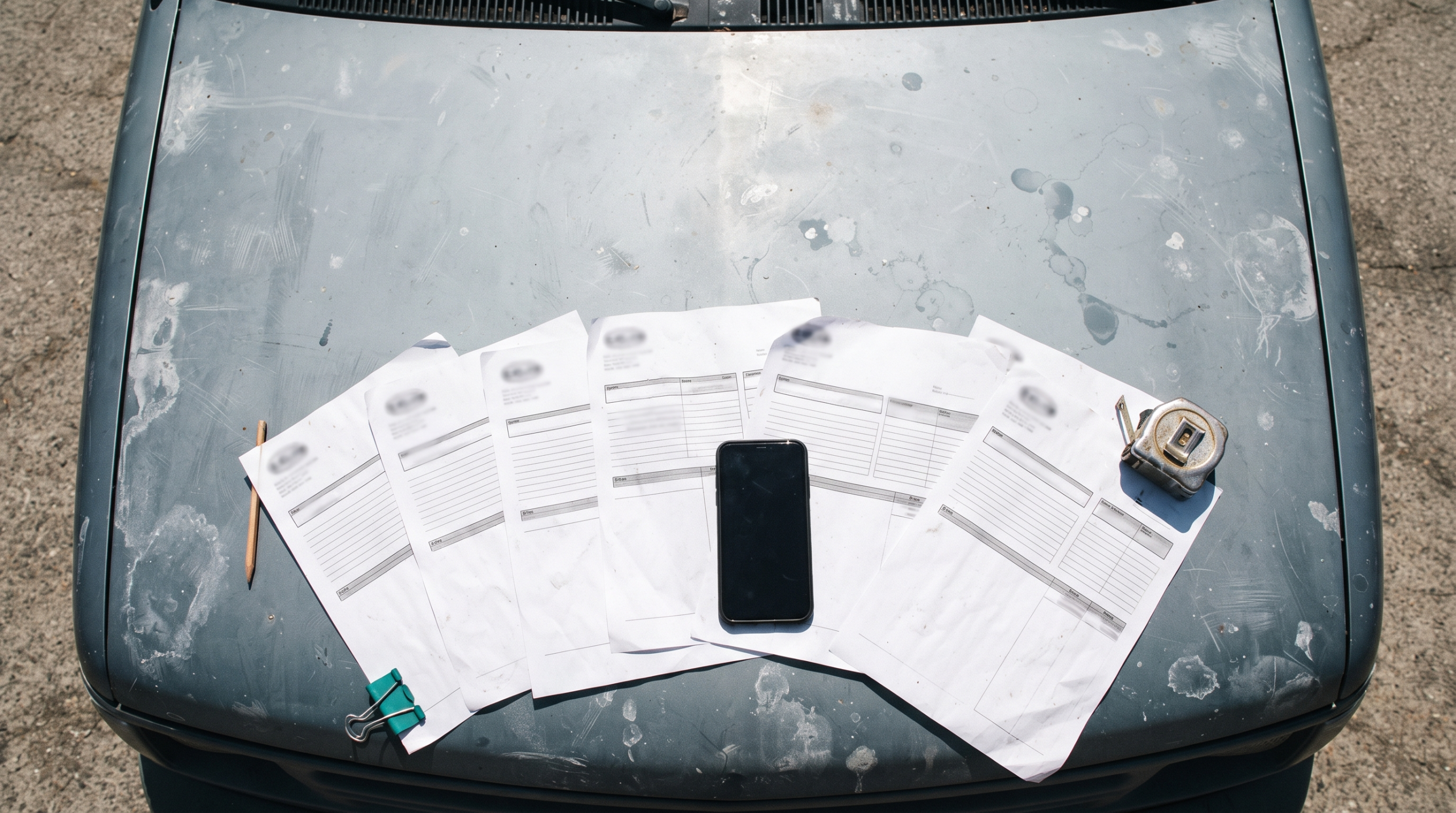
In July 2024 a painter started a thread on the Screwfix forum. He called it Tired, and the first line was this:
Tired of going around quoting for customers who never call back, tired of chasing up people for money, tired of “please can you just…”
Another trade replied to say he had gone the same way, and taken a job working for somebody else instead. Better pay, guaranteed, and an easier life.
That thread is from the summer before last, and the same one gets written every month, on every trade forum there is. So this post covers how to follow up on quotes, the first item on his list and the only one you can properly fix. Not the suppliers, not the money, not the “please can you just”. Just the quotes that go quiet.
For a one-man band, learning how to follow up on quotes properly beats almost any other admin habit. The whole thing takes about four minutes a week.
Why quotes go quiet
Start here, because the reason changes what you should do about it.
Silence is not usually a no. Ask any homeowner and you get a different picture. On r/AskUK last month, people asked whether hearing nothing back from a tradesperson is simply normal. Both sides of this are sitting in silence, each assuming the other has moved on.
The common reasons, roughly in order:
They are still collecting quotes. Conventional advice tells homeowners to get three. Yours arrived first and now sits in a pile while two more are arranged.
Somebody else has to agree. A partner, a landlord, a committee. Your quote is fine; the decision is not theirs alone.
The money moved. They want the work and cannot do it this month. Nothing about your price was wrong.
They forgot. Less flattering, far more common than anyone admits. Your email is nine screens down.
It is a no. Of course this happens too. Yet it is rarely the majority, and it is the only one of the five you cannot do anything about.
How to follow up on quotes without becoming a nuisance
The fear of being a pest is what stops most people, so let me deal with it directly. One follow-up is service. Two is normal. Three is persistence. Nobody has ever described a fourth as charming.
Here is a sequence that works for trade quotes, which behave differently from B2B sales because the job is physical, dated and often urgent.
| When | What you send | Why then |
|---|---|---|
| Same day | The quote itself, plus one line saying when it expires | The expiry date does the chasing for you later |
| Day 3 | A short check that it arrived and made sense | Early enough to be helpful rather than pushy |
| Day 10 | One useful fact: availability, a price change, a material lead time | Gives you a reason to make contact that is not “any news?” |
| Expiry week | A note that the price runs out, and an offer to re-quote | A deadline you set at the start, so it lands as information |
| Month 3 | One line, no pressure, closing the file | Catches the ones whose money arrived late |
Four touches over three months. That is not pestering anybody.
The single most useful item in that table is the first one. Put an expiry date on every quote you send, even if you are relaxed about honouring it. It turns your second and third contact from begging into admin.
What to actually say
Most advice on this subject is written for software salespeople and reads like it. A plumber sending that language to a woman who wants her bathroom done sounds like a stranger.
Keep it short, keep it specific to the job, and never open with “just checking in”. The job is the thing they remember, not you.
Day three, after a bathroom quote:
Hi Sarah, just making sure the quote for the bathroom came through alright — it went to the address you gave me on Tuesday. Happy to talk through any of it. Tom
Day ten, with a reason attached:
Hi Sarah, I’ve had a cancellation the week of the 14th, which is earlier than I quoted for. Worth holding for you? Tom
Expiry week:
Hi Sarah, the price I gave you runs out Friday — supplier put the tiles up in September. Still happy to do it at the quoted figure if you want it booked before then, otherwise I’ll re-cost it whenever you’re ready. No rush either way.
Notice what none of those do. They never ask whether she has “had a chance to think about it”, which invites a no, and they never apologise for making contact. Each one carries a piece of information she did not have.
How to follow up on quotes by text, call or email
Channel matters more than most people expect.
Email is where quotes go to die. It is the right place to send the document and the wrong place to chase it, because your message lands beside forty others.
Text and WhatsApp win for trade work, and the forums bear this out. When somebody asked the Screwfix community how they currently handle quoting earlier this year, the honest answers were WhatsApp, a spreadsheet, and pen and paper. That is the real stack on most vans.
Phone calls convert best and get used least, because nobody enjoys them. Save the call for the job worth having, after a text has gone unanswered.
Of course the rule bends to the customer. Somebody who only ever emails you should be emailed back.
How to follow up on quotes when twenty are out at once
None of the above matters if you cannot remember who owes you an answer.
The spreadsheet answer works, and plenty of good trades run on one. Four columns: name, job, price, date sent. Sort by date and the chase list writes itself every Monday morning.
Job management software does this properly, and if you quote twenty jobs a week it is worth the money. Tradify, Jobber and Simpro all track quote status and nag you automatically. The honest caveat is the monthly fee, which only makes sense once your quote volume justifies it. Before committing, it is worth seeing what those monthly fees add up to across a decade.
Paper also works. A pad on the dash with a line per quote and a date beside it beats a perfect system you never open. So does the contacts app already on the phone, which I have written up as running the whole thing out of Google Contacts.
What does not work is memory. Twenty quotes out, three weeks each, and the ones that slip are never the ones you expect.
Four minutes on a Monday
Whatever you use, book the time rather than relying on a mood. Open the list, find anything past its next contact date, send the three or four messages that are due, and shut it again. That is the entire system, and it is the difference between a 20% conversion rate and a 35% one.
How to follow up on quotes you sent months ago
Old quotes are the forgotten money in most trade businesses, and almost nobody goes back for them.
The approach differs from a fresh chase. Do not pretend it is still live, because the price almost certainly is not. Say plainly that you are closing the file, offer to re-quote, and leave it there.
Hi Sarah, clearing out my quotes from the spring and yours is still sitting there. Prices have moved since February so that figure won’t hold, but if the bathroom is still on the list I’m happy to come back and re-do it. If you’ve had it done, no problem at all — glad it’s sorted.
That message costs you nothing, and it reliably finds work. A proportion of those people never got it done and have been quietly putting it off.
When to stop
Three contacts and silence means stop. A fourth will not change the outcome and it will change what they think of you.
Mark it dead, put the name somewhere you will see it again, and move on. The exception is the month-three line above, which is not a chase but a closing note, and which people answer surprisingly often.
Somebody on an electricians’ group put the attitude better than I can: send the quote, and if you hear nothing, get over it. Harsh, though broadly right. The work is in the system, not in the worrying.
The half of this nobody plans for
Everything so far has been about you contacting them. The other direction is where the money actually lands, and almost nothing is written about it.
Three weeks after a quote your phone rings. A mobile number, no name you recognise. You answer, and somebody says “we’d like to go ahead” — and you have no idea which job, which price, or what you promised.
So you stall. You ask them to remind you what it was for. Perhaps you guess at the figure. Too low and you lose a few hundred pounds. Go too high and the job you had already won goes elsewhere.
That call is the single most valuable one you get all week. It is also the one you are least prepared for, because you were preparing to chase them, not to be chased.
The fix is unglamorous. Put the quote figure in the contact record on your phone. Not in a notes app, and not in the spreadsheet on the laptop. It belongs on the person, where your phone finds it when they ring. “Bathroom reroute, £2,400, quoted 3 Oct, expires 2 Nov” is a perfectly good note, and writing it takes ten seconds at the moment you send the quote. I have written separately about what belongs in a call note and where to keep it, and there is a printable version if the van runs on paper.
Being able to answer with the number already in your mouth is also, according to the research, how trust gets built on a call. Sarah does not know you looked anything up. She knows you remembered.
Where my app fits
I should state the interest plainly, since this is the part about my own product. There is an Android app of mine in this space.
Business Dialer Call Notes replaces your dialer and puts the note you keep in Google Contacts on the incoming call screen, before you answer. Name, company, and the line you wrote when you sent the quote. Edit it during or after the call and it writes back to Google Contacts.
It does nothing whatsoever about the chasing. No reminders, no quote tracking, no templates — everything above the last two sections, it has no opinion on. What it does is make sure that when the call finally comes, the number is on the screen.
It costs $9 a month, $49 a year, or $99 once, with a 30 day trial. Android only. The free version of the same idea is a note in your contacts app, which costs nothing. I have written that up in full, and if it gets you there, use it.
Questions about how to follow up on quotes
How long should I wait before following up on a quote?
Three days for the first contact, which is early enough to be useful and late enough not to be pushy. Then roughly a week later, and again when the price expires.
How many times should I follow up on a quote?
Three or four over about three months. Beyond that you are not persuading anybody, and the reputational cost starts to outweigh the chance of a yes.
Should I follow up on a quote by phone or text?
Text for the first two, because it is easy to answer and easy to ignore without awkwardness. Save the phone call for a job genuinely worth having, once a text has gone unanswered.
How to follow up on quotes without sounding desperate
Carry information rather than a question. A cancellation, a price change, an expiry date — each gives you a legitimate reason to make contact that has nothing to do with whether they have decided.
Is it worth chasing old quotes?
Yes, and it is the most neglected money in a trade business. Frame it as closing the file and offering to re-quote rather than reviving the old price.
The short version
Put an expiry date on every quote, because it does your chasing for you.
Contact them three times over three months, each with a reason attached, by text rather than email. Keep the outstanding list somewhere you actually open on a Monday morning, whether that is software, a spreadsheet or a pad on the dash.
And write the quoted figure onto the contact in your phone before you forget it. The chase is only half the job. Three weeks later the other half rings you, picks the worst possible moment, and expects you to know exactly what you said.