Position five on Google for this question is an article from CIO. It recommends Batchbook at twenty dollars a month for unlimited users, and the ContactMe “BizPro” plan at $7.42 monthly.
So I went to buy Batchbook. The domain does not load. No redirect, no sunset notice, no holding page — nothing at all.
That is a top-five result for cheap CRM for small business, on the world’s biggest search engine, recommending software you cannot purchase.
Look at the rest of the page and the pattern gets worse rather than better. Positions one and seven are both monday.com, two different articles, each leading with monday CRM. Zendesk’s list leads with HubSpot. ClearCRM’s list leads with ClearCRM. Every page answering this question was published by somebody who sells one of the answers.
I am no better, so let me say it now rather than at the bottom: I sell an Android app in this space, it costs $99 once if you want it, and it is in the table below with everything else. Most of this post is about not buying it.
Here is what the question actually costs to answer, with every price taken from the vendor’s own page this week.
Who writes these lists, and what they sell
Worth understanding the economics, because they explain the advice.
A CRM vendor that publishes “the best cheap CRMs” ranks its own product first and collects affiliate commission on the rest. That is not corruption, merely how content marketing pays for itself. The result, though, is a first page where every voice shares one interest: you subscribing to something.
Notice who is missing. No accountant, no trade body, nobody who bought one of these and regretted it. The only non-vendor results are Reddit threads, and the ones Google surfaces here are two years old with five comments.
Then look at the question that never gets asked. Every article assumes you are choosing between subscriptions, and argues about which monthly figure is smallest. None of them asks whether a one-person business needs a CRM at all, or whether you might buy one outright instead, because neither answer earns anybody a recurring commission.
What a cheap CRM for small business actually costs
First, a definition problem. Cheap means two completely different things depending on who is asking.
For a sales team of eight, cheap means a low number multiplied by eight, every month, forever. To a one-person business it means something closer to “an amount I will not notice”, and the difference between $7 and $15 matters far less than whether the thing gets used at all.
Both groups type the same words into Google. Only the first group gets written for.
Real prices, checked against the vendors this week
Three of the lists ranking for this term quote prices that have moved or products that have gone, so I opened the pricing pages myself in October 2026.
| Tool | Entry price | What free gets you | The catch |
|---|---|---|---|
| Google Contacts | $0 | Everything, no contact limit | No pipeline, no reminders |
| Zoho Bigin | $7 per user/month, billed yearly | One user, 500 records, one pipeline | Record caps bite sooner than you expect |
| Zoho Bigin Premier | $12 per user/month, billed yearly | — | Yearly billing to get that price |
| Less Annoying CRM | $15 per user/month | 30 day trial, no card | None that I can find, honestly |
| monday CRM | From $15 per user/month plus tax | Trial only | Priced per seat, and it grows |
| Business Dialer Call Notes | $9/mo, $49/yr, or $99 once | 30 day trial, no free tier | Android only, and it is not a CRM |
Less Annoying CRM deserves a word before I go further, because it is the one tool here that does exactly what it says. One price, every feature, no tiers, no contract, thirty days to try it without handing over a card. If you need an actual CRM and you have a team, stop reading and go and buy that one.
Why cheap CRM for small business lists disagree
Prices in this market move constantly, and the articles do not.
Vendors restructure tiers, move features up a level, and quietly raise the entry price at renewal. An article written in 2024 and never touched since will still be ranking, still quoting the old number, still collecting affiliate clicks. The CIO piece at position five is simply the most extreme case.
So check the pricing page. Always check the pricing page.
The arithmetic nobody on page one does
Every list compares monthly numbers. None of them multiplies.
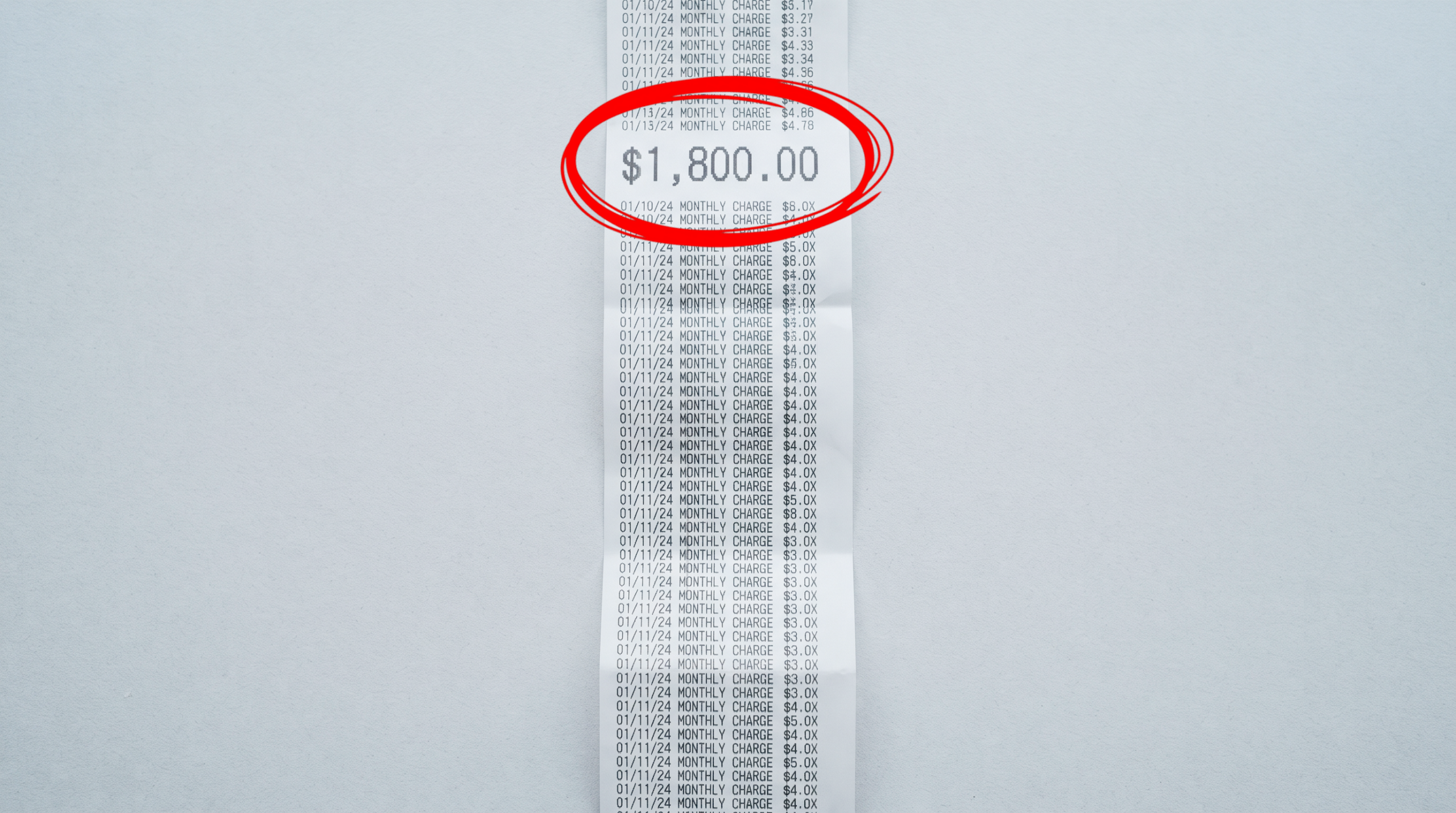
Seven dollars a month is eighty-four dollars a year. Over ten years of running your business, that is $840. Fifteen a month is $180 a year, or $1,800 over the same decade. Those are the real figures, and they are the ones a one-person business should be looking at, because you are not buying software for a quarter. You are buying it for as long as you work.
Eighteen hundred dollars, for software that holds a few hundred names.
None of that makes a subscription wrong. It does make “only $15 a month” a slightly dishonest way to describe the same figure.
The second thing nobody mentions: that price is per user. For a team it multiplies. Alone, you are already looking at the floor.
Buying a cheap CRM for small business once, instead of renting
Here is the part of the market the listicles skip entirely, probably because there is no recurring commission in it.
The top result for “one time payment CRM” is not an article at all. It is a thread on r/CRM with more than forty replies, from somebody asking which CRM you can simply buy. That question gets asked constantly and answered badly.
What a one-time CRM actually gets you
The products exist, though you have probably not heard of any of them. DejaOffice runs on the Windows desktop. CRM in Excel is exactly what the name says. LeadHub sells a lead CRM for $29 once. At the other end, one vendor on that same page asks three thousand dollars for a self-hosted licence.
Prices in this corner run roughly from $29 to $79 for the small desktop tools, which is less than six months of any subscription above.
What you give up by buying once
Plenty, and anybody selling you a lifetime licence should admit it.
You usually give up hosting, so the thing runs on your machine and your backups are your problem. Updates become a maybe. Support becomes a forum. Several of these products are one developer, and if that developer stops, you keep the software you installed and nothing else.
There is also a tax on your own time. Desktop software makes you the IT department: installs, a migration every time you change laptop, and a backup routine you have to remember unprompted. People who enjoy that genuinely enjoy it. Everybody else discovers the cost about eighteen months in.
A subscription, for all the arithmetic above, buys continuous development and a company with a reason to answer the phone. Of course that is worth something. Whether it is worth $1,800 over a decade is the question you are actually deciding.
The cheapest option is the one already on your phone
Before any of this, check whether you need to buy anything.
Google Contacts costs nothing, has no contact ceiling, syncs to every device you own and exports cleanly the day you want to leave. Labels give you rough stages. The notes field holds the history. For a few hundred relationships handled by one person, that covers more ground than most people expect.
The honest limit is that it stores well and retrieves badly. Nothing nudges you, nothing reports, and when the phone rings it shows a name rather than the line you wrote.
I have written the full setup as a Google Contacts CRM, and gone through every free personal CRM and the test most of them fail. Neither post asks you for money, because neither needs to.
When a cheap CRM for small business is still worth paying for
Three cases where I would tell you to spend the money.
You have staff. The moment two people share a contact list you need permissions and a record of who changed what. Less Annoying CRM at $15 flat does this properly, and no free arrangement will.
You need a pipeline and a number at the end of the month. Stages, deal values, a forecast. Bigin starts at $7 and does it well. Nothing free does it at all. Some trades do not want a pipeline whatsoever, which is the argument I make for insurance agents and their renewal months.
You need the software to chase you. Scheduled reminders with teeth. Mesh and Dex both do that; a contacts app never will. If your problem is forgetting rather than storing, pay somebody.
That last one is worth sitting with. Most people searching for a cheap CRM are not short of storage. They are short of a habit, and software is a poor substitute for one — an argument I made at more length elsewhere.
Where my app fits
I promised to be plain about this.
Business Dialer Call Notes replaces your dialer. It reads the note you keep in Google Contacts and puts it on the incoming call screen, with the name and company, before you answer. Edit during or after the call and it writes back to Google Contacts.
It is not a CRM and I will not pretend otherwise. No pipeline, no deal values, no reminders, no reporting. Everything in the table above does more than it does.
What it fixes is one specific thing: the moment somebody you spoke to three weeks ago rings back and you cannot place the name. Your notes exist, yet Android hands the call to the dialer and the dialer shows a name. That gap is the whole product.
It costs $9 a month, $49 a year, or $99 once, with a thirty day trial and no free tier. The $99 is the number I would point at in a post about renting versus owning. Pay it and there is nothing further to pay, ever.
Your notes stay in your own Google account either way, so if you leave, the writing you did is still there. That was deliberate.
Questions about a cheap CRM for small business
How much does a CRM usually cost?
Entry plans for small business tools sit between $7 and $20 per user per month, with the lower prices usually requiring annual billing. Enterprise platforms run far higher. Pricing moves often, so trust the vendor’s page over any article, including this one.
What is the cheapest CRM for a single user?
Free, if Google Contacts covers you. Among proper CRMs, Zoho Bigin has a free single-user tier capped at 500 records, and paid plans start at $7 per user per month billed yearly.
Is there a 100% free CRM?
Yes, with conditions attached. HubSpot’s free tier is real but designed to sell you the paid one. Monica is free if you host it yourself. Google Contacts is free with no tier and no ceiling, though it is a contact manager rather than a CRM.
Is a cheap CRM for small business any good?
Often better than an expensive one, for a small operation. The cheaper tools tend to do less, which means less to learn and less to abandon. Most CRM failures are abandonment rather than missing features.
Can I buy a CRM with a one-time payment?
You can, though the choice is narrow and mostly unfamiliar names. Expect roughly $29 to $79 for desktop-class tools, self-hosting in many cases, and no guarantee of future updates.
The short version
Check the pricing page yourself, because a good share of the advice ranking for this search is out of date and some of it recommends products that no longer exist.
Then do the multiplication. Fifteen dollars a month is eighteen hundred dollars a decade, which may well be worth it, but you should decide that on the real number rather than the small one.
Start with what you already own. Google Contacts may well cover you, in which case stop there. Need a pipeline? Bigin is $7. With staff, Less Annoying CRM is $15 and genuinely does what it promises. And if the whole idea of renting software forever bothers you, a one-time purchase market does exist — small, unglamorous, and almost entirely unwritten about.
That is also where I keep my own price. Make of that what you like; I have taken somebody else’s pricing apart in the same spirit.